
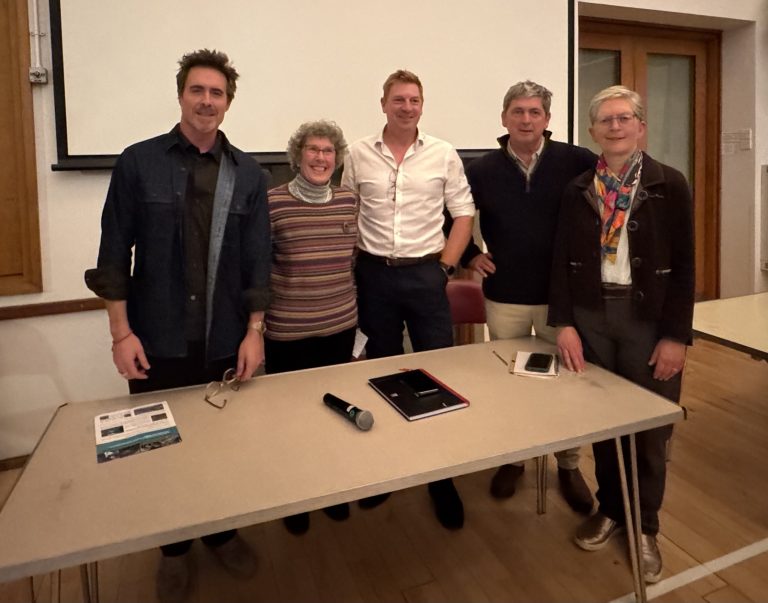
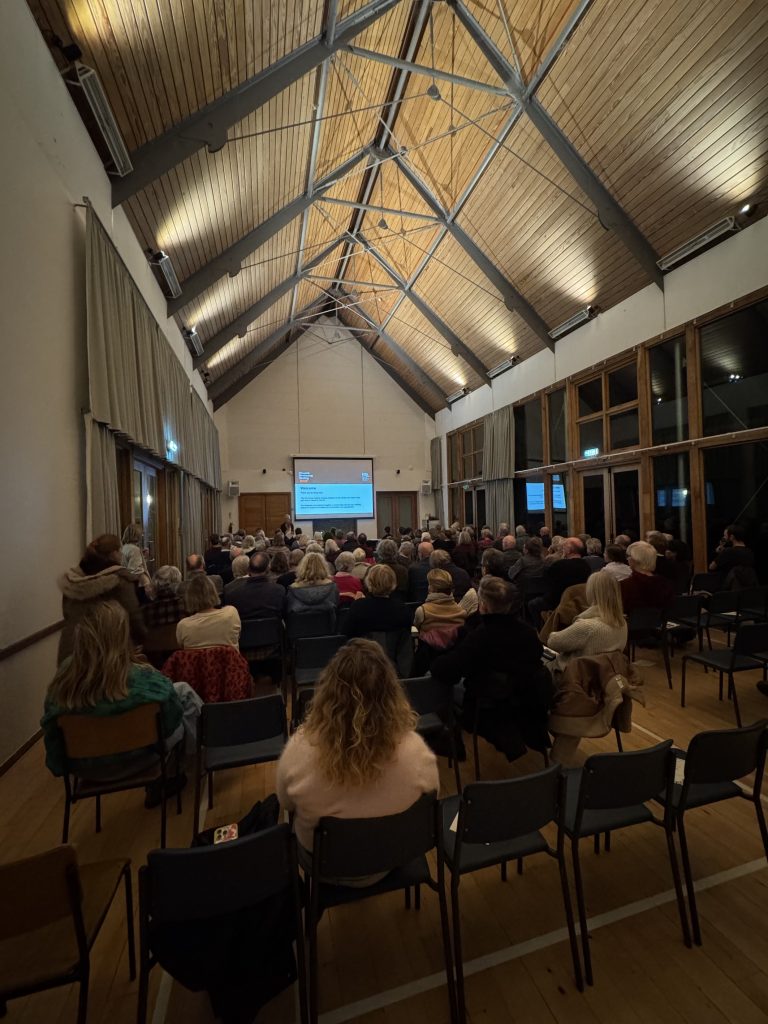
On Tuesday 17th November, we were delighted to welcome 140 people to a screening of the People’s Emergency Briefing in the Itchen Abbas and Avington Village Hall. The People’s Emergency Briefing is a 50-minute UK documentary film about the climate and nature crisis. The project stems from a live event held in November 2025 in Westminster, where leading UK scientists and experts briefed Members of Parliament and national leaders on ecological and climate risks.
It is a hard-hitting documentary, covering many aspects of the climate crisis, including weather extremes, food security, national security, economics and health. A discussion followed the film, where attendees were invited to comment on what they had seen, share their thoughts and ideas about what we can do as individuals and communities, and ask questions of our panel of speakers. The panel featured Simon Ashton, meteorologist at Nebu Weather; Jim Murray MBE, river conservationist and activist; Jackie Porter, County Councillor for Itchen Valley and Robert Stent, Chair of Winchester Downs Cluster.
The panel were invited to comment on what they had seen, with Jackie generously sharing the very personal experience of her mother’s death due to heatstroke as a result of one of this year’s extreme heatwaves, with hospital staff having to shower themselves fully dressed in order to keep cool. Jim told us he was surprised at how imminent some of the effects look to be, and that it is clear we need urgent government action. Simon said it was shocking to see the various impacts all brought together in the film, and felt that redirecting finances intelligently would be key to mitigating these. Robert brought it back to individuals and communities, pointing out that we can achieve a lot locally and that farmers can be part of the solution.
Unsurprisingly, with a challenge as wide-ranging as the climate crisis, there were more questions posed than answers given. Topics of conversation spanned finance and economics, extreme weather, home energy and retrofitting, land use and diet, transport, biodiversity and nature, development and planning.
The overarching question posed by many was “What should we do next?”. The People’s Emergency Briefing campaign asks us to lobby our MPs, and it was agreed that this is an important step, but with our local MP clearly in support of climate action, attendees wanted to know what they could do themselves, specifically, and what would have the biggest impact. There was demand for clear information and instruction, and a suggestion that the government and our authorities ought to be giving us that information.
In response to this request, New Leaf has put together an initial list of suggestions for the most impactful next steps you can take to contribute to mitigating the climate crisis. We hope you will find the information below helpful, but if you have a specific question or suggestion, or you would like our help to progress an idea you have for your community, please get in touch and we will do our best to help.
The general consensus was that communication, collaboration and community are key to finding and effecting solutions, and that the momentum built by the People’s Emergency Briefing should not be wasted. In the short term, those local to Itchen Abbas can support action on our waterways at the Upper Itchen Conservation group’s Clean Green Roadshow at the Village Hall next Monday 23rd November from 7pm. Discover how you can help to protect our chalk streams, with some straightforward swaps to cleaner greener household products. We can all help reduce the build up of harmful substances and allow our chalk streams to recover and thrive into the future. Book your free place here.
New Leaf thanks Shelley Hughes for proposing the screening, Jackie Porter for helping us achieve this with a grant, The Grange for supplying welcome refreshments, all attendees and our brilliant panel of volunteer speakers.
We have collated some useful resources here, and offer a few suggestions for changes you might be able to make in your own lives. Everyone’s circumstances are unique, however, and you must identify what you can reasonably achieve for yourself. These are suggested actions – it is not a prescriptive list.
Make greener travel choices
In the UK, transport is the largest domestic emitting sector at 30% of CO2 emissions.
Reducing the number of flights you take is a good first step. Day-to-day travel is a challenge in rural areas, where private vehicles are often the only option. If this is the case, please consider an electric car when it comes to purchasing your next vehicle. The used electric car market is now seeing strong demand. Ensuring that you share journeys wherever possible is another good change to make, and choosing public transport or other modes such as walking and cycling when this is achievable.
Find some green travel suggestions on the New Leaf Alresford website
Choose a plant-rich diet
Meat and dairy account for 12% to 19% of global human-caused greenhouse gas emissions, with animal products driving the majority of food-system emissions.
Plant-rich diets result in significantly lower greenhouse gas emissions, land use, water consumption, and pollution compared to diets heavy in animal products, because raising livestock requires far more resources than growing plant foods directly for human consumption. Natural habitats, such as the Amazon rainforest, are being lost to make way largely for intensive cattle farming and production of animal feed.
Get smart with home energy
Home energy accounts for roughly 20% of UK greenhouse gas emissions, driven mainly by burning fossil fuels for heating and hot water alongside electricity consumption.
There are many ways to reduce your carbon footprint at home, from lowering your thermostat and installing sufficient insulation, to replacing windows and installing new technologies. The My Home Made Better initiative from Winchester Action on the Climate Crisis (WinACC) can offer you free, unbiased and tailored home energy advice.
Find much more information and book a free advice call with My Home Made Better
Explore New Leaf’s suggestions for making your home greener
Green up your finances
Greening your pension could cut your carbon footprint up to 21 times more than stopping flying, going vegetarian, and switching energy providers combined!
The UK’s leading banks still contribute billions into fossil fuel projects. Nearly £3 trillion is invested in pensions in the UK, with most funds invested in big stock markets, which include oil and gas companies. Investments from UK pension schemes enable the release of 330 million tonnes of carbon every year. Thankfully, switching bank accounts and divesting pensions are quick, straightforward and very effective ways to make a huge difference.
Find out more, including links to rankings tables from Friends of the Earth
Further actions you can take include buying fewer new things and resisting single-use items, reducing your waste, recycling, repairing, improving your gardens and green spaces for wildlife, and of course getting involved with local climate action with New Leaf Alresford, WinACC, Upper Itchen Restoration CIC, Upper Itchen Valley Society, Project White Hart, and more.